
Between Scotland and Jerusalem
The poems of A.C. Jacobs, who was always between places on the page.

The Scottish-Jewish poet A.C. Jacobs, who deserves more readers, was haunted by the concepts of diaspora and home. When in Scotland, he wrote about Jerusalem, and when he was in Jerusalem, he remembered Scotland.
As I read his Selected Poems, I found myself thinking of the Greek word diaspeirein, meaning “to scatter, spread about,” because for Jacobs, remembered or imagined landscape is also scattered, or spread about, whatever he is looking at, wherever he is. These landscapes are also spread throughout the poems, as if mimicking the actual physical diaspora and the wandering embedded within it.

Edinburgh Castle.
The word “diaspora,” which comes from the Greek diaspeirein, has been part of the English language for over 400 years. Diaspora, with a capital D, “can be found as far back as 1594, in a translation of Lambert Daneau’s A Fruitfull Commentarie vpon the Twelue Small Prophets, the Merriam-Webster Dictionary reports. “This scattering abrode of the Iewes, as it were an heauenly sowing, fell out after their returne from the captiuitie of Babylon … they are called Diaspora, that is, a scattering or sowing abrode.”
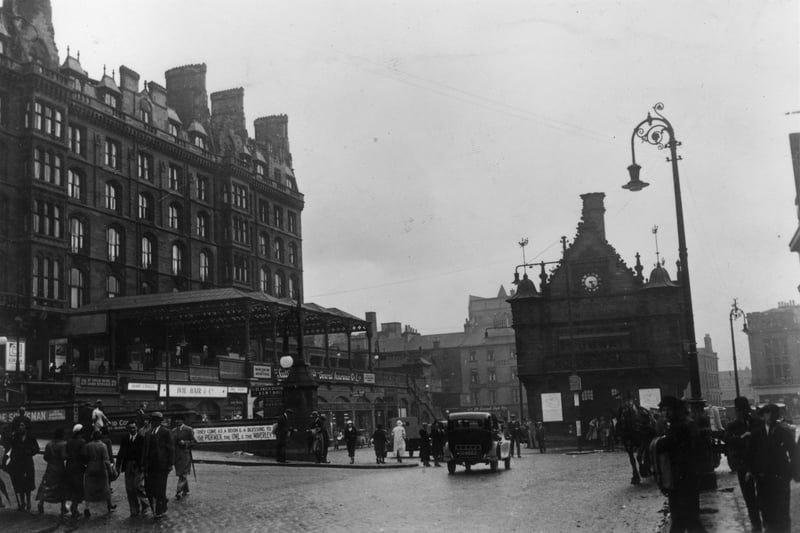
St. Enoch subway station in Glasgow, in front of the St Enoch’s Hotel, September 1933.
This “scattering or sowing abrode” was the story of the Jacobs family. He was born in Glasgow in 1937 into an Orthodox Jewish family. “With his grandparents on both sides being Jewish immigrants from Lithuania, Jacobs’ upbringing was influenced by the Yiddish language (often combined with the Scots vernacular of the Gorbals in Glasgow) and the lingering shadow of the Holocaust,” according to the Scottish Poetry Library. “He received a traditional Jewish education and attended secular Scottish schools before his family moved to London in 1951.”
Arthur, or A.C. Jacobs, who died in 1994, published exactly one book and one pamphlet of original poetry in his lifetime, and perhaps this slim output is what drew him to translating the great Hebrew poet Avraham Ben Yitzhak, who published exactly eleven poems during his time on earth. (I will highlight one of these translations in a future newsletter. ) After Jacobs’ death, many of his unpublished poems were discovered by friends and family in homes in both London and Madrid. Those poems were published in Collected Poems & Selected Translations (ed. John Rety and Anthony Rudolf, 1996) and again in Nameless Country: Selected Poems of A. C. Jacobs (ed. Merle L. Bachman and Anthony Rudolf, 2018).
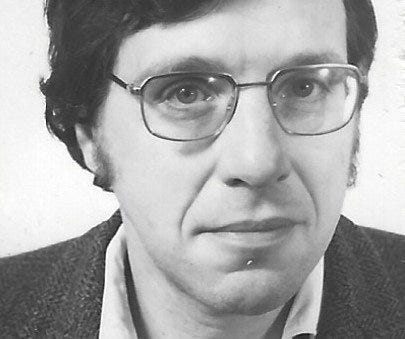
Arthur C. Jacobs (1937-1994)
It’s not so easy to find The Collected Poems, which includes some of the translations Jacobs worked on. The Selected Poems, edited by Merle Bachman and Anthony Rudolf, published in 2018 by Carcanet Press, is a good introduction to his work. Jacobs lived in Israel for a few years; some of his poems reveal a troubled relationship to the country, and a continuing interest in diaspora.
You can hear all of this in “In Green Hills,” one of the many poems that move between landscapes and states of mind. Here Jacobs is, in Europe, remembering Jerusalem. But is it the Jerusalem he saw with his own eyes, and lived in? Or was it the Jerusalem he longed for, perhaps the Jerusalem promised in Jewish text?
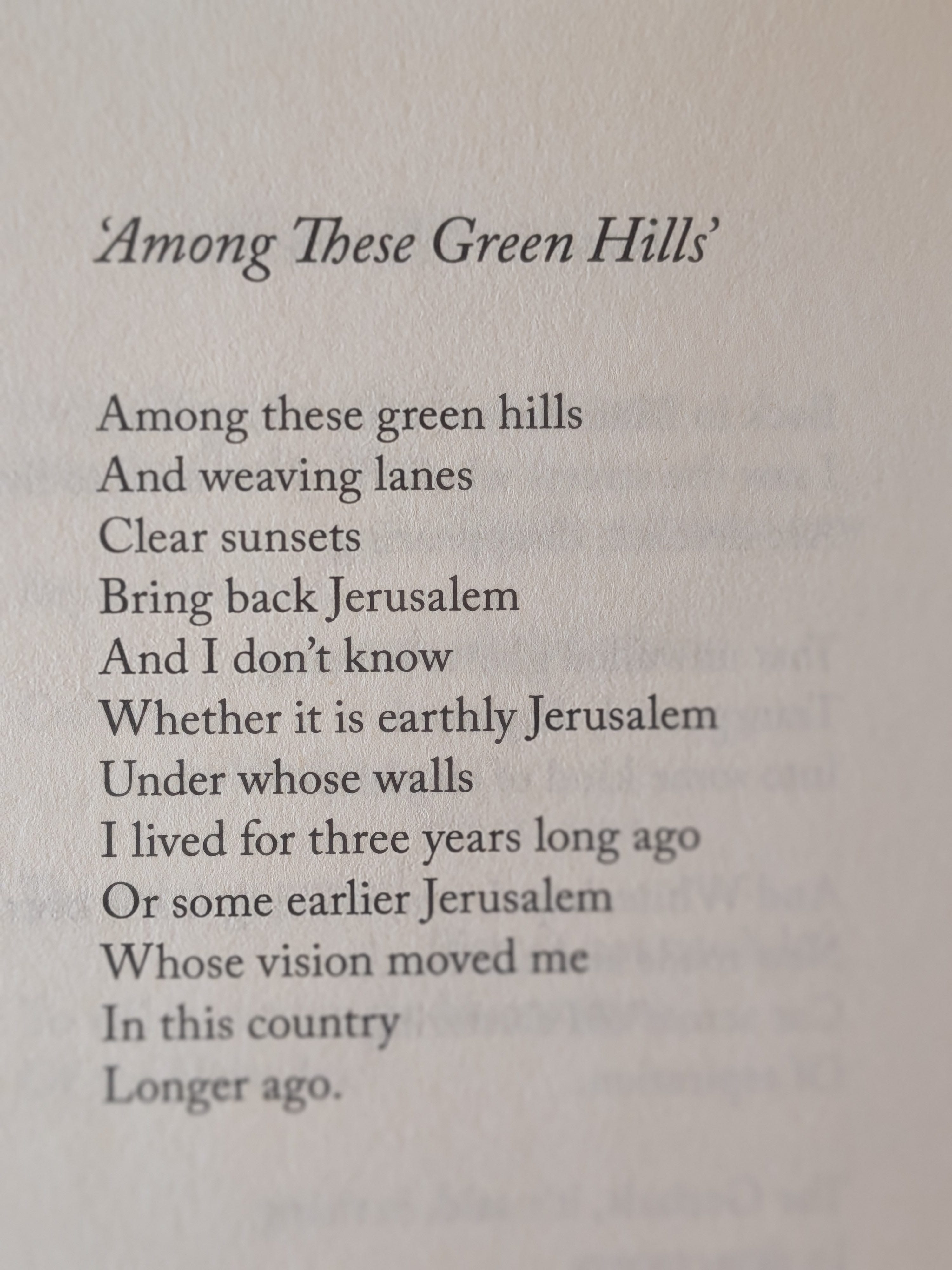
Jacobs did not stay in Jerusalem forever. He returned to Scotland throughout his life, and he also lived in Italy before settling in Spain. He also kept returning to subjects like Jewish life in the aftermath of the Holocaust, the fate of Yiddish, his family and his ancestors, and of course, Scotland, England, and Jerusalem. In addition to Ben Yitzchak, he also translated David Vogel from the Hebrew and Yiddish, and those were published in a volume titled The Dark Gate (Menard Press, 1976).
One of Jacobs’s strongest poems is the last poem in Selected Poems, which captures much of what interested Jacobs, throughout his life. I think the editors chose well by giving it this placement:
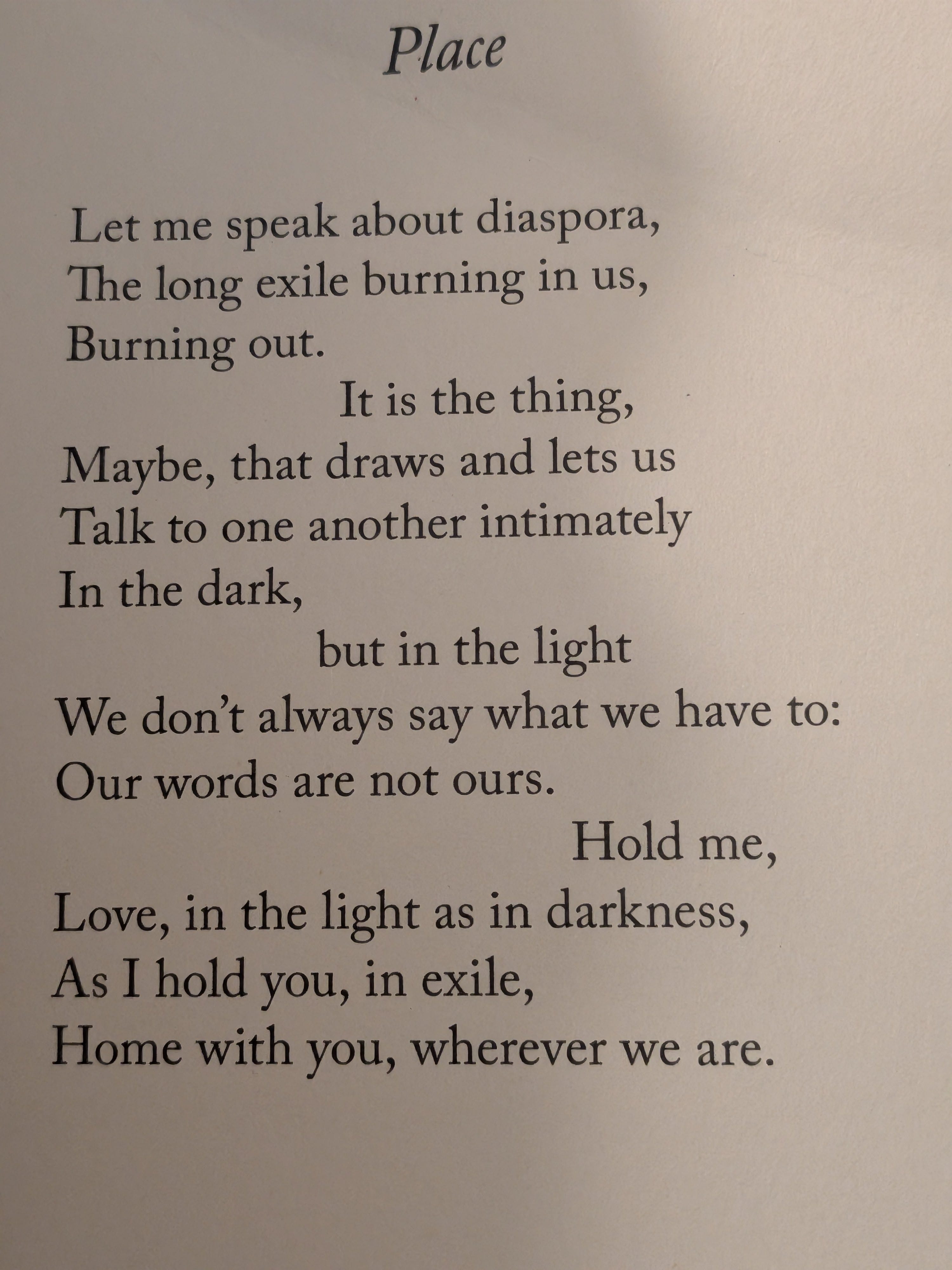
The diaspora and the “long exile burning in us” is on many minds lately. The idea of being home with a person, or being at home, in exile, has been talked about before; it’s back now, with a flurry of recent books.
None of this is new terrain; Jacobs, like many Jewish writers throughout the centuries, undoubtedly thought about diaspora, exile, and what home is over and over again. You can even feel that wandering in wavering moments in individual lines.
That is the case in “State,” and in particular, the question mark at the end. Musician Boy George, speaking in the aftermath of the stabbing of two Jews in Golders Green in London, a heavily Jewish neighborhood, observed that no one is asking Americans or Russians to individually answer for those countries’ actions. The stabbing was just the latest in a spate of antisemitic attacks in the United Kingdom.
The opening line, “Here in my native country/ I’m answering for somewhere else” seems especially apt and contemporary now.
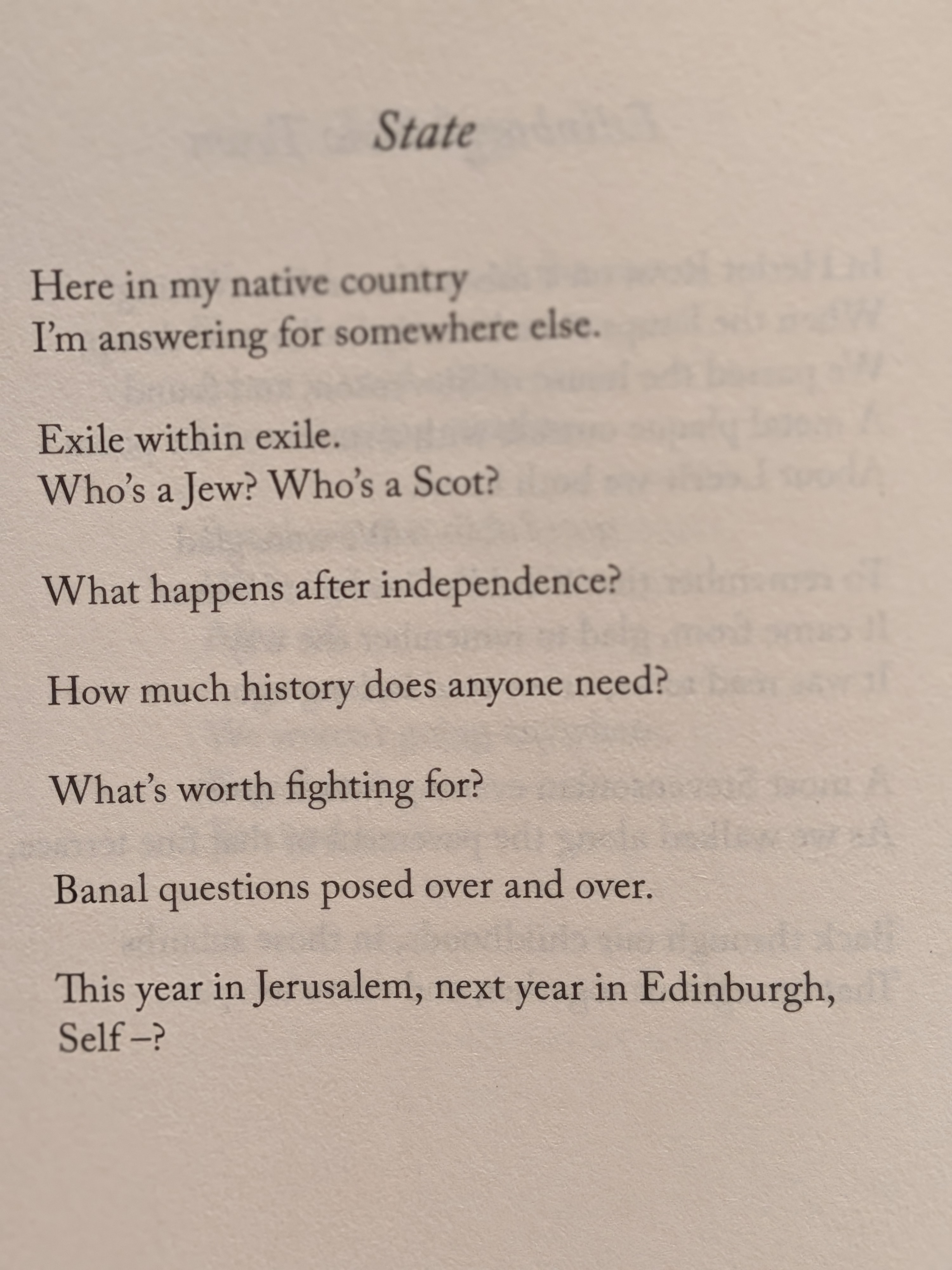
The line “exile within exile” is haunting. Reading Jacobs is a reminder that perhaps all of this has been there all along, and maybe we just weren’t listening closely enough.
Next Salon: Merle Bachman on A.C. Jacobs
Perhaps because of his lifelong search for a true home, Jacobs was intrigued by Esperanto, the dream of a common language for all of humanity. The next newsletter will spotlight one of his translations along with a poem he wrote to honor the inventor of Esperanto.
Stay tuned for part II of “Between Scotland and Jerusalem”—and hope you join us for the upcoming salon featuring poet, translator, and scholar Merle Bachman, who will discuss her work editing Nameless Country: Selected Poems by A.C. Jacobs, and offer a window into his life and poetry. More details soon. Shabbat shalom!
************************************************************************************************************
Hope you found this newsletter meaningful! Thank you for your support of writing with depth.