
Celebrating Robert Pinsky
A dispatch from Boston, where the fantastic poet and teacher is retiring.

I’m in Boston for my wonderful teacher Robert Pinsky’s retirement reading tonight. “I just write poems,” Robert once wrote. “I am an expert on nothing except the sounds of sentences in the English language.”
That is an understatement.
Right now, all over Boston and Cambridge, Robert’s former students are coming back to honor him, and to say thank you. Poets are flying in from all over the country; others are coming in by train and by car. I saw two at dinner last night, and look forward to seeing more tonight.
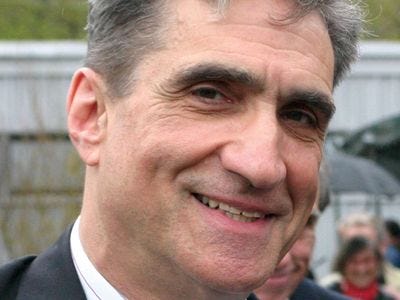
Robert Pinsky, as photographed in 2005 in the Encyclopedia Brittanica.
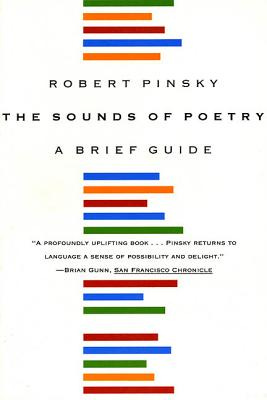
When he was my teacher, Robert was the Poet Laureate of the United States. His most recent collection is Proverbs of Limbo published in June 2024 by Farrar, Straus and Giroux. Other books of his include The Figured Wheel: New and Collected Poems 1966-1996, a Pulitzer Prize finalist., Gulf Music (FSG, 2007), and Jersey Rain (FSG, 2001). And of course, there is his translation of Dante, and The Sounds of Poetry: A Brief Guide.
Then as now, Robert was tremendously dedicated to bringing poetry to a wide audience, most famously with his Favorite Poem Project. My favorite of the “favorite poem” videos features a school’s head custodian whose favorite poem is “The Waking” by Theodore Roethke; you can watch it here. I re-watch it all the time, because it reminds me of what matters.
I always feel that the head custodian understood “The Waking” in his bones, and that he was a great teacher in his own right. Robert would stop at nothing to reach such readers. In fact, I remember distributing poems at a T station as a student during National Poetry Month. I don’t remember how that happened, but I have a feeling Robert’s influence was part of it.
“Pinsky is the only member of the American Academy of Arts and Letters to have appeared on “The Simpsons” and “The Colbert Report,” his bio states. I found that Robert was an expert on much more than just sound, though I certainly learned about sound from him. He taught me a great deal about poem structure, about revision, and about the art of staying the course. It’s not easy to continue in poetry, but Robert helped.
Three Lessons from Robert Pinsky
There are three suggestions Robert made that I think of, again and again. I share them in case they will help you—as a writer or as a reader.
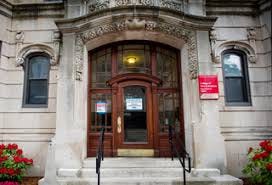
The entrance to 236 Bay State Road, home of Boston University’s writing program.
The first was Robert’s comment that often, the second stanza is the first, and the second-to-last stanza is the last stanza. I have used this brilliant insight in poetry, but also in prose. I often realize that I started too late or ended too late. Sometimes I translate Robert’s comment to pages, or chapters, or even book sections. And I thank him silently.
The second comment was when he told me not to throw out my drafts. It is true that sometimes we make things worse when we revise; going back can help. I learned to save, and to humbly return, and to realize that going forward sometimes means going back.
And the third comment is something I didn’t understand then, and only half-understand now.
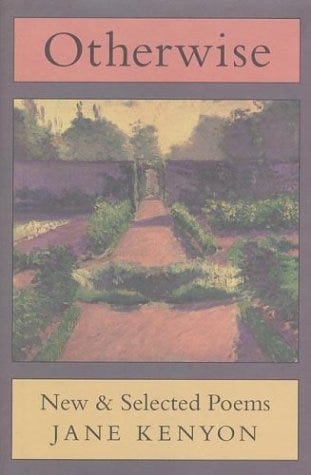
Robert once told me my endings were too heavy-handed. I truly didn’t understand, at 23, what “heavy-handed” meant, so I forced myself to read only “quiet” poets for a year. I read a lot of Jane Kenyon, and all of Emily Dickinson, who I thought then was quiet. (She’s not.) But reading poets who knew how to hush helped me, somehow, thought I can’t explain exactly how.
The truth is that the best teachers teach us in ways we cannot exactly explain.
“Shirt” by Robert Pinsky
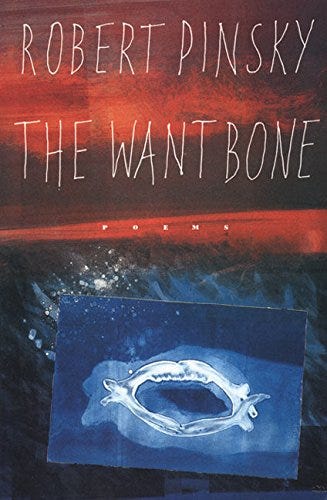
I remember reading “Shirt” – one of Robert’s more famous poems—while trying to decide where to go to graduate school. I wanted to study with poets who changed over time, who did something different in different books. I was amazed by the craftsmanship; if you haven’t read it in a while, here are the first six stanzas, along with a link to the rest.
The poem is from The Want Bone, published in 1990. It was reprinted in The Figured Wheel: New and Collected Poems (Farrar, Straus and Giroux 1996).
“Shirt” is steeped in history—namely, the Triangle factory fire in 1911. I like reading it out loud, though Robert reads it better. (My friend Tom Yuill is a close second when it comes to reading this poem.) This poem is in tercets—three-line stanzas, but somehow Substack seems to want to erase that, no matter what I do!
If you are reading this on a laptop, you might see the tercets. If you are on a phone, please imagine them or read the poem here at the Poetry Foundation site.
SHIRT
The back, the yoke, the yardage. Lapped seams,
The nearly invisible stitches along the collar
Turned in a sweatshop by Koreans or Malaysians
Gossiping over tea and noodles on their break
Or talking money or politics while one fitted
This armpiece with its overseam to the band
Of cuff I button at my wrist. The presser, the cutter,
The wringer, the mangle. The needle, the union,
The treadle, the bobbin. The code. The infamous blaze
At the Triangle Factory in nineteen-eleven.
One hundred and forty-six died in the flames
On the ninth floor, no hydrants, no fire escapes—
The witness in a building across the street
Who watched how a young man helped a girl to step
Up to the windowsill, then held her out
Away from the masonry wall and let her drop.
And then another. As if he were helping them up
To enter a streetcar, and not eternity.
You can read the entire poem by Robert Pinsky here at the Poetry Foundation’s website. (The formatting looks better there, too.)
Pinsky and Precision
You can see the precision that many poets learn from Robert Pinsky. And you can also see, if you read the whole thing, how Robert mentions other poets—Hart Crane and George Herbert. I ended up reading both of those poets with him during that precious time in Boston. Robert was and is always generously mentioning other poets, and teaching from them.
My salient memory of Robert will always be his constant recitation of the W.B. Yeats line: “Nor is there singing school but studying/ Monuments of its own magnificence.” (It’s from "Sailing to Byzantium.") The only way to learn to write poetry is to read it. But you know what? Being around great poets definitely helps.
Poets as Friends
I learned that from watching Robert as a friend. His poet friends were deeply important to him, and he invited them to teach a class—to teach us, too.
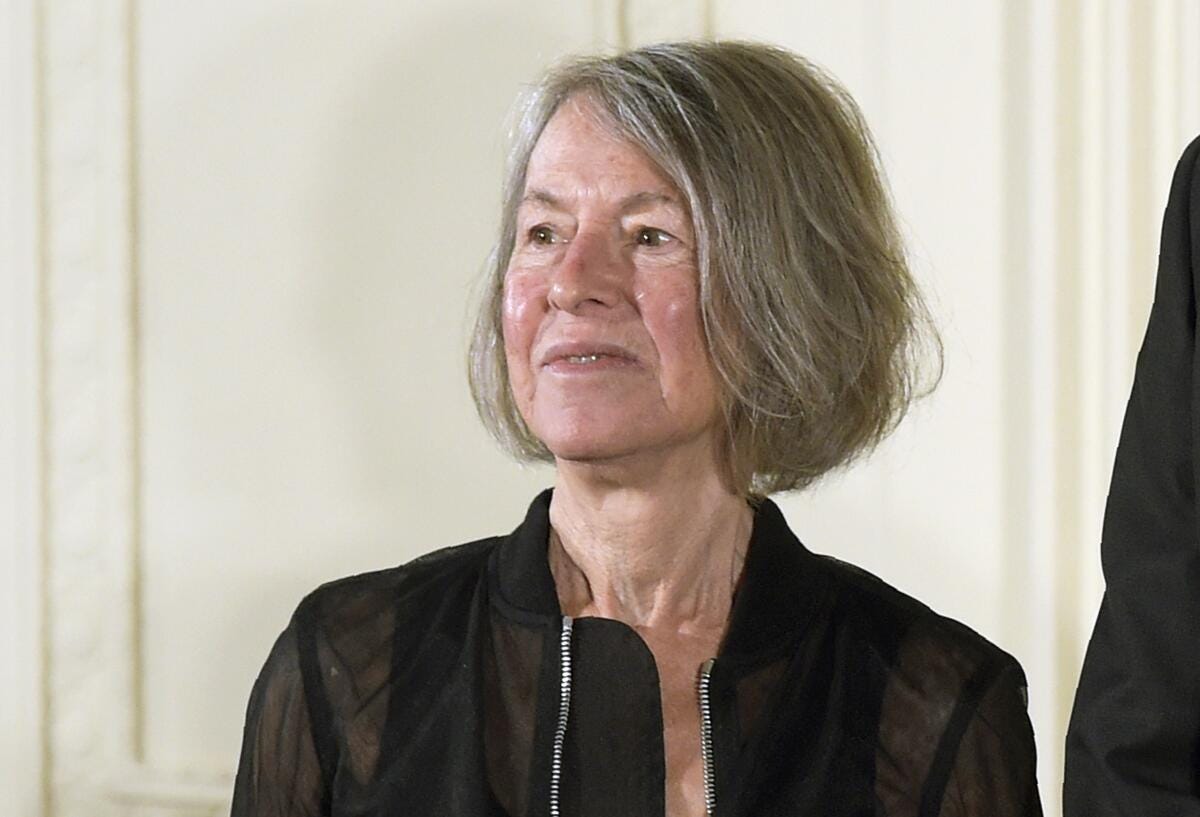
The late great poet Louise Glück, who once told me she took her poems to Robert Pinsky to help make them better. That was enough of a recommendation for me to go study with him.
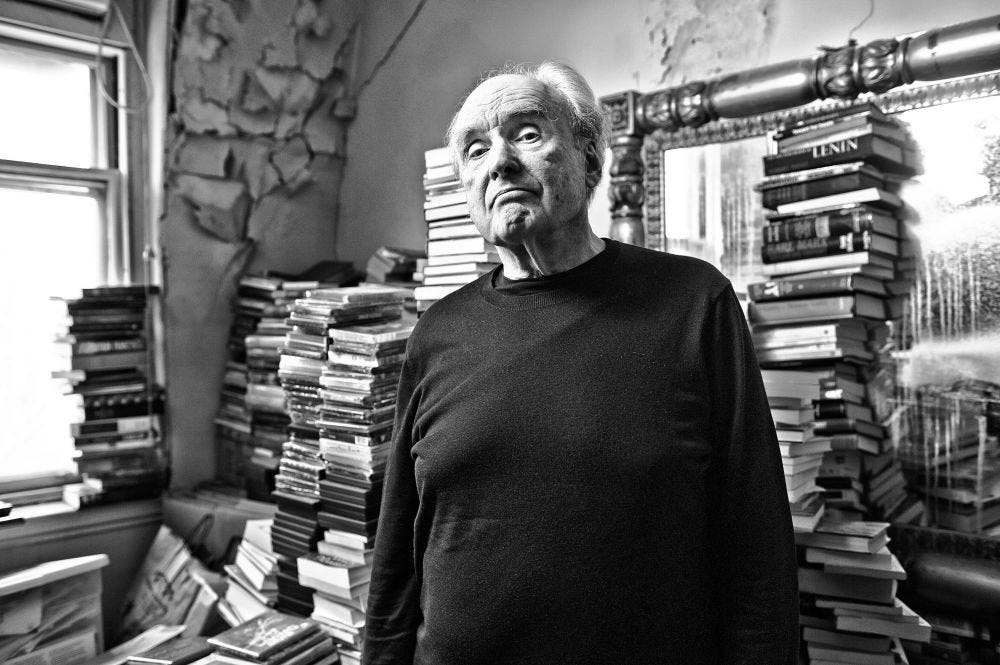
Robert Pinsky invited the wonderful poet Frank Bidart, pictured above, to teach a class. I still think about his comments on punctuation. Robert, Louise, and Frank were all close friends.
Perhaps friendship can be extended to the great poets of the far past. Now is a good time to say that I recommend reading Robert on Isaiah, and I specifically love his chapter on his bar-mitzvah haftarah, Isaiah 66. To my eye, it’s about how understanding everything isn’t always necessary.
It’s a thought I believe anyone who immerses themselves in the Torah eventually considers—because the ancient is simply so far from us. Here is a snippet: “The beauty of chanting words with their meaning mostly inaccessible, with every flame-shaped character on the scroll related to breath— somewhere in that maimed ceremony was my avenue toward giving my life to poetry.”
It’s such a beautiful sentence. I’m grateful that Robert Pinsky was part of my avenue to poetry. Thank you, Robert, for everything.
New Essay in The Forward
In many ways good teaching is about empathy. I’m always fascinated by moments of extreme empathy, and I’m also always interested in what the media does not focus on. Both of those came together in a remarkable scene captured on video during a recent terror attack in Jerusalem, and it really got to me. I wrote about it in an op-ed for The Forward; you can read it here. Thank you to Talya Zax for her editing and patience.
Reading in Chicago Next Sunday
I’m looking forward to reading at The Chicago Loop Synagogue in Chicago next Sunday with four lovely poets! Doors open at 1, there will be a generative workshop at 1:15, and the reading starts at 2. Come for part or all—would love to see you!
This event is part of Yetzirah, a hearth for Jewish poetry, and is a continuation of the Chicago Loop Synagogue’s effort to be a home for Jewish culture.
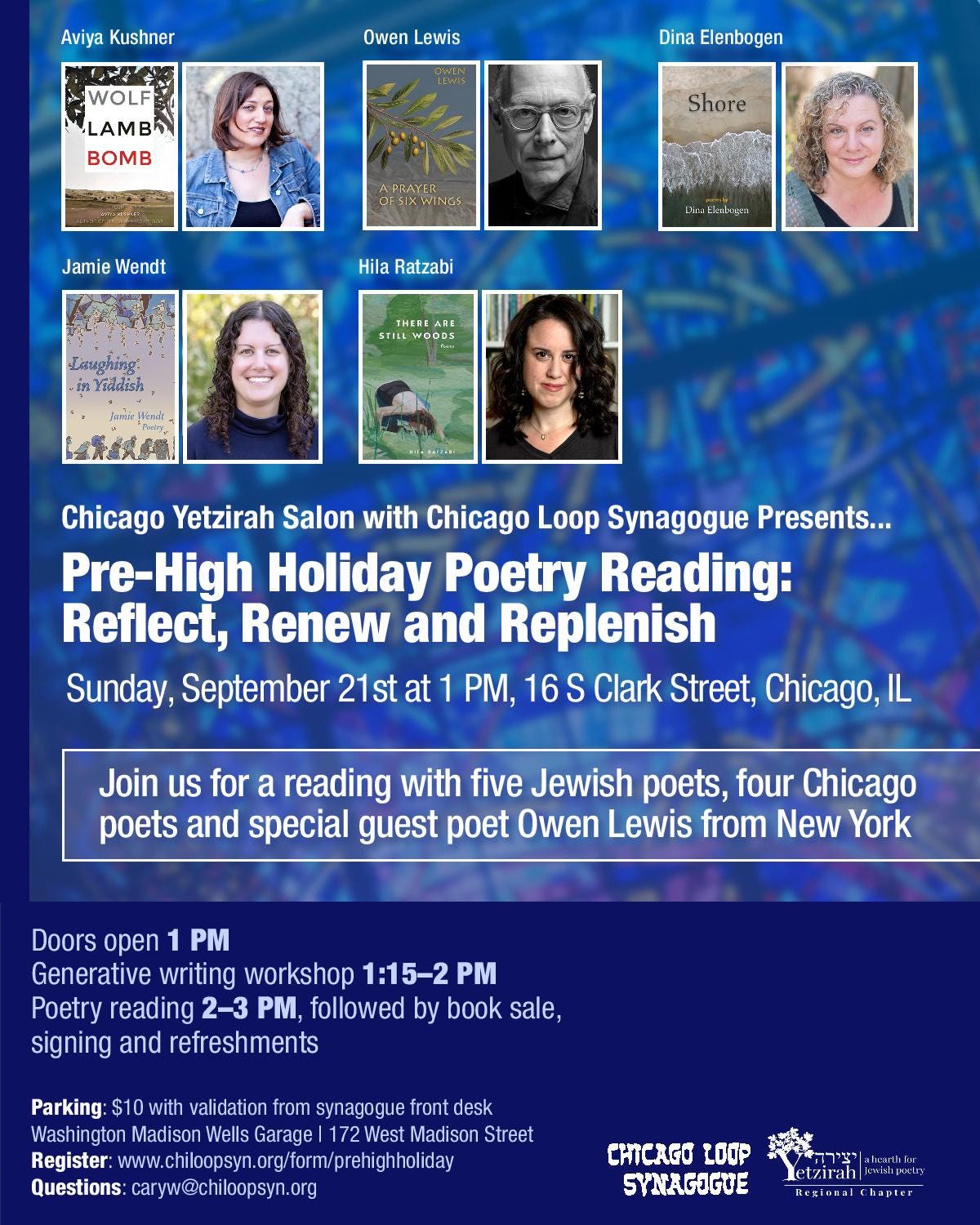
This coming year, I am excited to offer a menu of talks and classes. If you would like to invite me to speak or teach or give a reading, you can contact me directly at Aviya dot Kushner at gmail dot com. I’m also happy to design something specifically for your campus or organization.
A Piece on Samuel Menashe
I know many readers of this newsletter are eager to read about Jewish poets who deserve more attention. So here is a shout-out to Dan Friedman, the former managing editor of The Forward, who wrote about the late Samuel Menashe—a poet I also met by chance in New York.
Not long ago, while doing a mentor gig for The National Yiddish Book Center, I met a young translator who was deeply influenced by Menashe….and I thought of how Menashe continues to find his readers, in all kinds of ways, including through someone translating Yiddish sonnets. You can read Dan’s piece here.
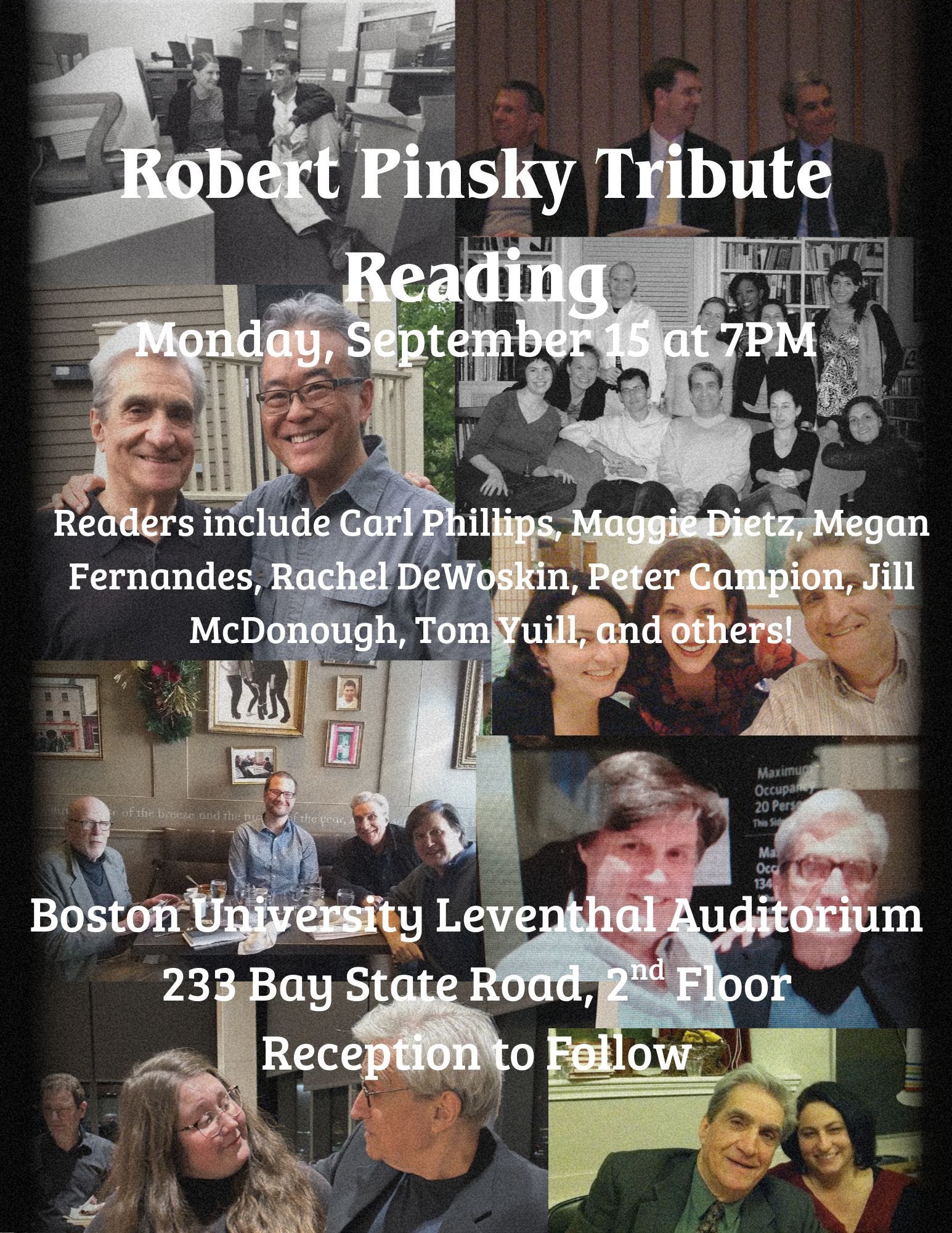
And last but certainly not least, if you’re in Boston and want to celebrate Robert Pinsky—come tonight! In the poster below, and in the pictures you can see poets David Ferry, Tom Yuill, Maggie Dietz, and many more. If you see me tonight, please do say hello!
**********************************************************************************************************
Hope you enjoyed this newsletter! Thank you for your support of writing with depth.
Lovely piece, Aviya! I encountered Pinsky as an undergraduate at BU and got that first piece of advice through his students, who taught poetry workshops to undergrads.
As I do with many of your pieces, Aviya, I am saving this to go back to again. A wonderful piece about a great poet. It's lovely to hear he's been celebrated this way by his students. Thanks!