
Translating Between Continents
When a Scot translates Hebrew.

The Scottish-Jewish poet A.C. Jacobs wrote in English and translated from Hebrew; Avraham Ben Yitzhak was born in Poland, and lived for a time in Vienna. Eventually, Ben Yitzhak made his way to Israel and wrote in Hebrew. This kind of travel across languages—and lands—is not unusual in poetry, and it is often the story in poetry translation.
I was familiar with Ben Yitzhak’s exquisite Hebrew poetry and with an intriguing translation into English published in 2003 by Peter Cole at Ibis Press, which Cole founded. (For those interested in poetry news—several Ibis titles will be re-issued by Wesleyan University Press in 2026.) There was a time when I found myself in conversation with other poets about Ben Yitzchak, and his addictive, mysterious lines; that hasn’t happened for many years, and I don’t know why.
I also did not know that Ben Yitzhak once had another English-language translator who was also a poet—Jacobs, who happened to be working on the translations when he died in Madrid, shortly before his 57th birthday. After his death, many of Jacobs’ unpublished poems were discovered by friends and family in his residences in both London and Madrid,” the Scottish Poetry Library notes. https://www.scottishpoetrylibrary.org.uk/poet/a-c-jacobs/#:~:text=Read%20more “
Those have been published first in Collected Poems & Selected Translations (ed. John Rety and Anthony Rudolf, 1996) and later in Nameless Country: Selected poems of A. C. Jacobs (ed. Merle L. Bachman and Anthony Rudolf, 2018).” In case you missed it, I wrote about Jacobs and his poetry in the newsletter here, in part I of this two-part series on Jacobs: Between Scotland and Jerusalem
Jacobs grew up in Scotland and lived in Israel for a few years; some of his poems reveal a complicated relationship to Israel, and a continuing interest in diaspora. His poems don’t fit into the easy boxes of “feeling at home with Israel” or “feeling disillusioned with Israel.” He returned to Scotland throughout his life, and he also lived in Italy before settling in Spain.
As I re-read Jacobs, I found myself thinking of Paul Celan, who also grew up in an Orthdox family, and also wrote of Jerusalem but lived in Europe, where he was born. Jacobs also lived in a post-Shoah world; his subjects, familiar to those who read post-ward Jewish poetry, included “the exhaustion of Jewish life after the Holocaust, the death of Yiddish, the honouring of his pious … Jewish ancestors, the urban impact of his birthplace Scotland, the English landscape, Jerusalem,” Anthony Rudolf, a friend of Jacobs and the co-editor of his Selected Poems, observed.
All of this terrain was familiar to Ben Yitzchak. Here is a famous Ben Yitzhak poem. The first word, ashrei, is familiar to many from the tefillot, the prayers. The word “ashrei” is translated variously as “happy,” “blessed,” and in the case of Chabad, “fortunate.” You can see why a poem that starts with this word might appeal to Jacobs, who grew up in an Orthodox family:
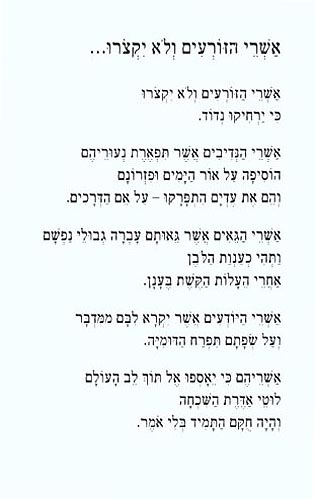
From: Poems, Avraham Ben Yitzhak
Publisher: Tarshish (1952) 1968,
And here is Ben Yitzchak, in a Jacobs translation:
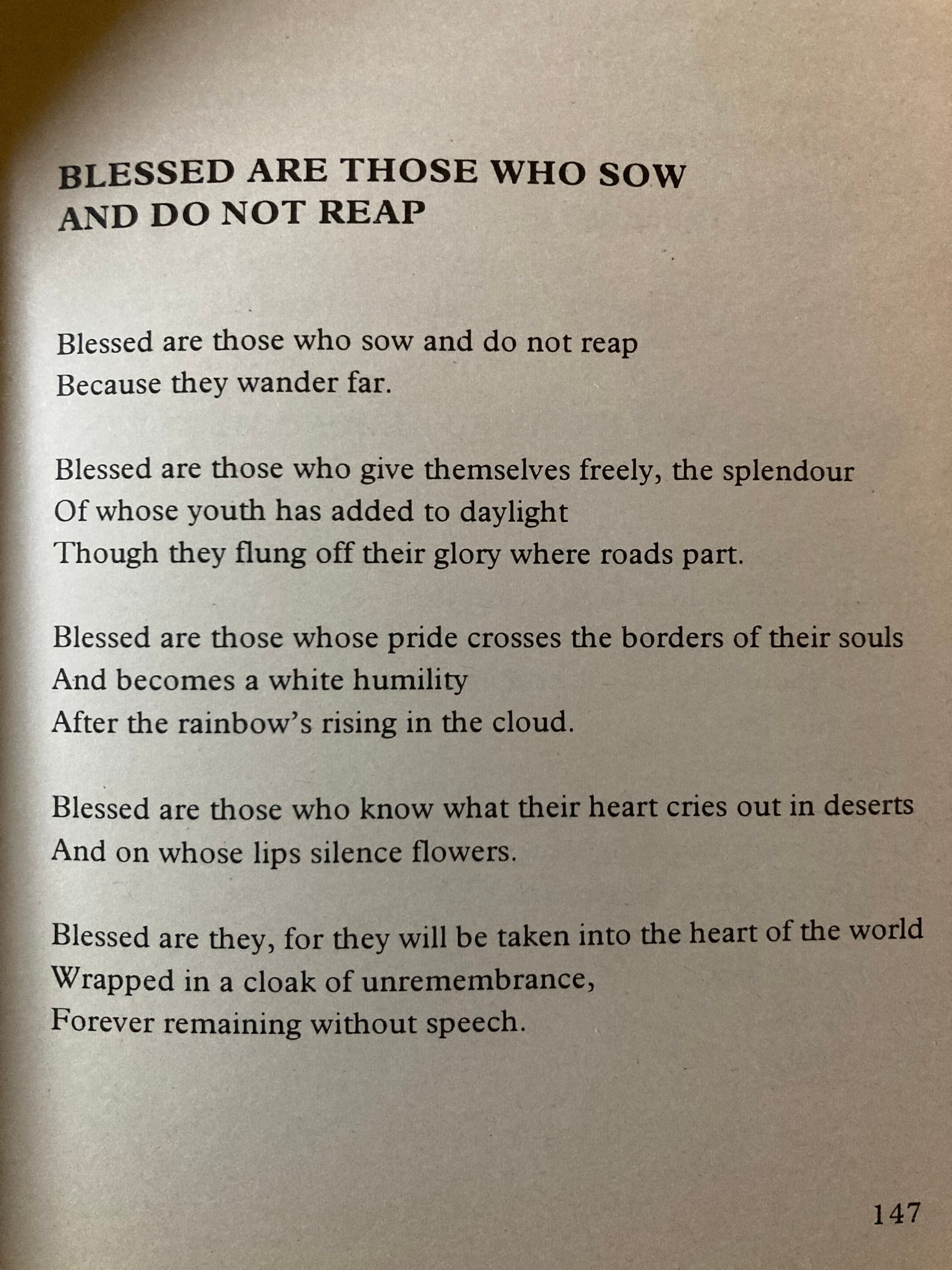
Even if you do not read Hebrew, you can make out what Jacobs kept from Ben Yitzchak—the stanza length. Stanzas that are two lines long in Hebrew are two lines long in English.
But you can also see that Jacobs came up against a challenge that all translators from Hebrew to English face—namely, that the Hebrew language is more compact and condensed than English is. You can see this in the title, which morphs from four words in Hebrew to nine in English. Jacobs also decides to get rid of the ellipsis in Hebrew, when he translates the title.
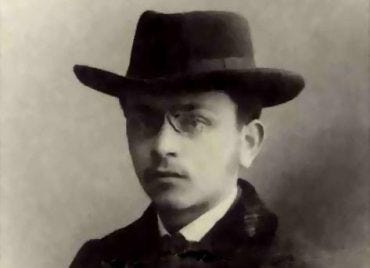
The poet Avraham Ben Yitzchak
The word ashrei immediately evokes a famous daily prayer for Hebrew speakers. Ashrei is said at least three times daily, and it is taken from the Book of Psalms. The first two verses are from Psalms 84:5 and Psalms 144:15 and the last verse is from Psalms 115:18. All the rest is from Psalm 145.
But the title and first two lines evoke another famous Psalms verse—126: 5. “They that sow in tears shall reap in joy.” But what if, Ben Yitzchak wonders, they sow but do not reap? Here, Jacobs catches the overall tone of the Ben Yitzchak poem, which is complex and questioning. While Ben Yitzhak’s answer to the reason they do not reap is that they wandered for, there is room, perhaps, for the reader to wonder about other reasons. While the famous daily prayer is all praise, and often said aloud, this one ends in eternal speechlessness.
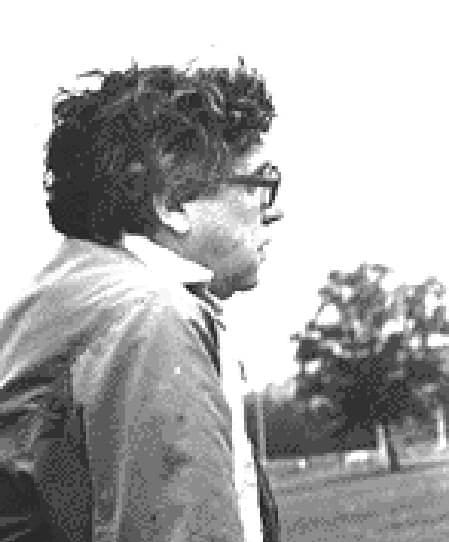
The Scottish poet A.C. Jacobs, who translated Ben Yitzchak
Do You Know What I Prayed for in These Days?
Reading the Jacobs translations of Ben Yitzhak sent me back to Leon Weiseltier’s translations of a few fragments by Ben Yitzhak, who Wieselter refers to as Ben Yizhak, in The Jewish Review of Books. They appeared a decade ago.
It’s jnteresting to consider how many poets and thinkers found their way to Ben Yitzchak and his slim output—Peter Cole, A.C. Jacobs, and Leon Wieseltier, to name a few. (I’m listing them in alphabetical order.)
“My translations of these fragments are based on Hannan Hever’s superb edition of the complete poems. He dates them to 1913, 1919, and 1924. I dedicate them to Harold Schimmel,” Wieseltier writes, referring to another well-known Hebrew-to-English translator. I think the opening line here is so fitting for our times.
******
Do you know what I prayed for in these days
as I passed between the houses into which the
afternoon silence was gathered
the tough cypress standing tall before them
like a candle-soul reveling in its holiness?
I prayed that it would be given to me at the
fading of the day
to place my hand upon the bolt to your room
and find you draped in darkness
with just your head subsisting
in a golden sphere of restful light
and your fingers dispersed to the edges of the
piano
until the sounds rise and you are forgotten
and only your soul will make a stir
which will reach me.
****
You can read more fragments at The Jewish Review of Books.
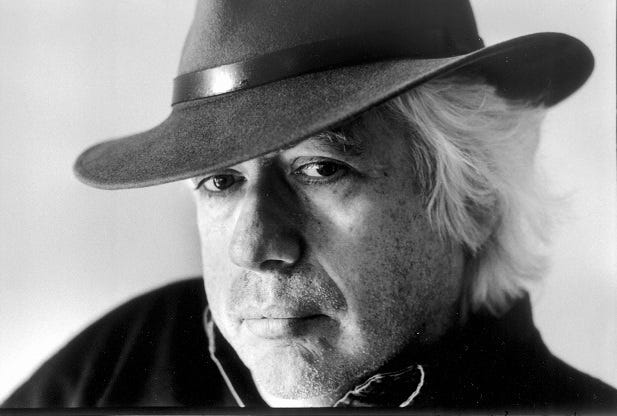
Leon Wieseltier, writer, critic, and editor.
And stay tuned for details of an upcoming salon with poet, translator and scholar Merle Bachman, who edited the selected poems of A.C. Jacobs, in a volume titled Nameless Country. I am grateful to Merle for bringing Jacobs to my attention.
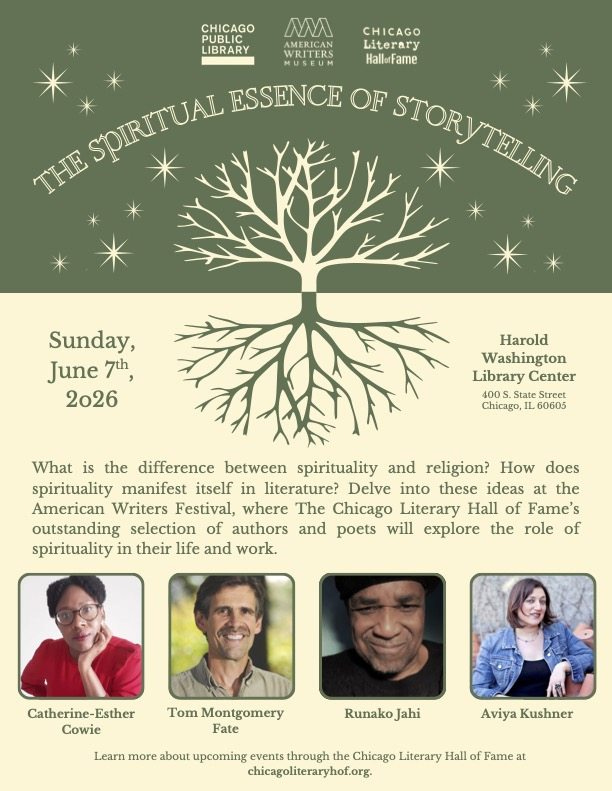
American Writers Festival: June 7th in Chicago
Summer is festival season, and I’m delighted to participate in a panel on “The Spiritual Essence of Storytelling” at the American Writers Festival with several wonderful writers. This event will take place at the Harold Washington Library in downtown Chicago, and it is free to attend. The full schedule is on the American Writers Museum website, and some other events will be held at the museum. Hope to see you there!
**********************************************************************************************************
Hope you enjoyed this newsletter! Thank you for your support of writing with depth.
Muchísimas gracias, Aviya. You know, subscribing to your blog is the best thing I did on my behalf last year. As I read the Psalms or the epistles of the Apostle Paul, I often think of the poets you have introduced me to through your workshop. (That's how I imagine this blog, the public-facing part of your workshop.) I have been edified. Looking forward to the next live event, to hear poets talk about how they create their work, how their travels and sojourns help them cultivate ideas.
Oh, very lovely Aviya, and you now have me hooked on finding the other translations of Ben Yizhak.....!!! Thank you so much... Merle